WePoker Hall Bot
 How a WePoker 茶馆 club economy works
A WePoker hall is a private club opened by a group admin (群主), populated by agents (代理) who recruit players and advance them chips, and reconciled through an off-application settlement chain rather than a regulated cashier. Monetary settlement and trust are intermediated by identifiable individuals at each role. The position occupied by each party determines where automated play, collusion, and disputed payouts can be situated within the club.
The three roles that run a club
Almost every hall reduces to three layers. They are simple, but the incentives between them are where most disputes start.
| Role | Chinese | What they control |
|---|---|---|
| Group admin | 群主 | Opens the club, sets stakes and rake, approves members, holds the master ledger. |
| Agent | 代理 | Recruits players, fronts (lends) chips, collects debts, takes a cut of rake-back. |
| Player | 玩家 | Buys in through an agent, plays, settles up at the end of the cycle. |
The admin rarely deals directly with most players. The agent is the human interface — the person who vouches for you to the admin, and who chases you for money if you lose. That layering is exactly what makes a club scalable, and exactly what makes it opaque.
It is worth being precise about the incentives, because they are not aligned the way newcomers assume. The admin wants volume and a stable, paying membership; their income is the rake, so in the simplest reading they are neutral about who wins. The agent's income, by contrast, is tied both to rake-back and to keeping their recruited players solvent enough to keep playing — which gives the agent a direct stake in how much each of their players loses, and to whom. A player who busts and cannot pay is a liability that lands on the agent first. That single fact shapes almost every downstream behaviour in a club, from how aggressively agents extend credit to how disputes get resolved.
How clubs find members — and unions (联盟) above them
A hall does not advertise on a public lobby; it grows by referral. You typically arrive through someone you already know who is an agent or a trusted member, and your reputation inside the club is initially borrowed from theirs. This is why clubs feel exclusive — not because they are prestigious, but because the credit model only works among people who can plausibly chase each other for money.
Above individual clubs sits a larger structure that newcomers rarely see: the union or alliance (联盟). A union pools several clubs so that their tables share liquidity — more clubs feeding the same games means fuller tables and shorter waits. The union operator sits one layer above the club admins, taking a slice of the combined rake and setting cross-club rules. For a player this is mostly invisible, but it matters for trust: the people you are seated against may come from a different club entirely, governed by an admin you have never dealt with, settled through a chain you cannot see.
The practical consequence is that "who runs this game?" rarely has a single answer. There is the club admin you joined under, the agent who fronts your chips, and possibly a union operator coordinating liquidity across rooms. Each layer adds a place where information, money, or a dispute can get stuck.
Buy-ins and credit: why nobody actually "deposits"
In a licensed room you deposit real money and the operator holds it. In a 茶馆 there is usually no on-app deposit at all. Instead, chips are credit. An agent gives you a chip balance on the understanding that you will settle the real-world difference later — by bank transfer, a payment app, or cash.
This credit model has two consequences worth stating plainly:
- You are extended trust before you play. The agent is effectively your lender, so they have leverage over you the moment you sit down.
- Losses are debts, not lost deposits. If you lose, you owe a person, not a platform — which is why collection (and intimidation) is part of the model in a way it never is on a public site.
Credit limits are themselves a lever. An agent who extends you a generous line is not being kind; they are increasing the size of the swing they can collect on. Conversely, an agent who tightens your credit after a winning session is quietly managing their own exposure. None of this is necessarily dishonest — it is ordinary lender behaviour — but it means the "free" feeling of playing on credit hides a relationship in which the other party always knows exactly how much you are down and has both the information and the leverage to act on it.
Rake-back and the settlement chain
Rake is the cut the house takes from each pot. In a club, that rake flows up the chain: the admin sets it, agents earn a slice for the volume they bring, and players may be promised partial rake-back as an incentive to keep playing. At the end of a cycle — often weekly — everyone reconciles.
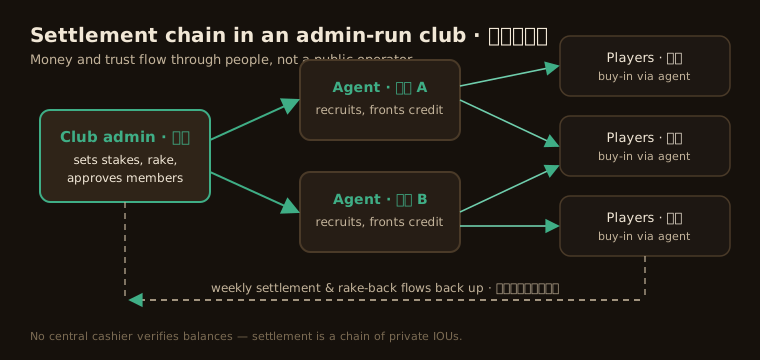
Notice what is missing from that picture: an independent party who verifies every balance. The admin's ledger is the source of truth. If two people disagree on what is owed, there is no neutral cashier to appeal to — only the admin, who is also the most conflicted party in the room.
Where automation and collusion fit
Now the part that gets people searching for "bots". There are two distinct things that often get blurred:
1. A bot as a grinding tool
A player (or an agent) can run software that plays a tight, patient strategy across many tables to extract small edges over volume. From a developer's view this is a multi-table game-playing agent with the usual constraints: it reads the visible table state and chooses an action. It does not need to see hidden cards to be profitable — it just needs to out-discipline humans who tilt.
2. Privileged abuse by people in the chain
The more damaging risk is structural. Because admins and agents hold position, they can run secondary accounts (小号) at your table, or share hole-card information across a coordinated group (联合作弊, collusion). This is not a "bot" in the AI sense — it is people exploiting access. A bot can amplify it (automating the small accounts), but the root cause is the privileged position, not the software.
Keeping these two apart matters because the defences differ: outside bots are a detection-and-policy problem, while privileged abuse is a governance problem that no anti-bot tool can fix.
3. The settlement layer is where it compounds
There is a third place automation quietly enters, and it is the least discussed: the bookkeeping itself. A union or large club reconciling thousands of hands a week does not do it by hand — it runs scripts against exported hand and transaction data to compute who owes whom. That is legitimate and even necessary. But the same data pipeline that computes settlement is also the ideal vantage point to spot the profitable accounts, the consistent winners, and the seats worth quietly seeding with a small account. Automation at the settlement layer is rarely "the bot" people fear, yet it is where the structural advantages of holding position turn into a repeatable process rather than a one-off.
Where disputes actually start
If you watch a club long enough, the recurring conflicts are remarkably predictable, and almost none of them are about a hand of cards. They are about the seams between the layers we have just described.
- Settlement disagreements. A player and an agent remember the week's results differently, and the only authoritative record is the admin's ledger. Without shared, exportable history, this is unresolvable except by trust.
- Credit disputes. An agent who fronted chips wants to collect; a player who feels the game was not straight wants to withhold. The credit relationship turns a poker loss into an interpersonal debt with no neutral arbiter.
- Cross-club seating. In a union, you may not know which club an opponent belongs to. When a winning streak looks suspicious, there is no single admin who owns the problem — the liability diffuses across the alliance.
The common thread is that the structure removes the neutral third party that a regulated operator provides for free. Every dispute resolves to "whose word do we trust?", and the person whose word counts most is usually the one with the strongest financial interest in the outcome.
A research framing, not a how-to
We study these structures to understand how poker software behaves in environments without a neutral operator. Nothing here is an instruction set for running a club or cheating one. If anything, the takeaway runs the other way: the club economy concentrates trust in a handful of people, and that concentration — not any single piece of software — is the thing to evaluate before you sit down.
The companion piece looks at the fairness question head-on: can you trust the deal and your opponents when one person controls the room?