WePoker Hall Bot
Fairness in private, admin-run WePoker clubs
Fairness in a WePoker 茶馆 is determined by two distinct components. Deal integrity refers to the platform's RNG and client software and is generally not the principal risk. Conduct integrity refers to the behaviour of the human administrator and the agents, who hold privileged positions within the club and may engage in multi-accounting, collusion, or settlement abuse. Automated playing agents are one element of this risk profile but not necessarily the most consequential.
Separate two questions that always get merged
"Is it fair?" combines two questions:
- Deal integrity Are the cards random and unseen? This is about the RNG and the client software.
- Conduct integrity Are the people honest? This is about admin power, collusion, and settlement.
Most public worry fixates on the first. The evidence and the structure point at the second.
Deal and RNG integrity
A poker RNG's job is to shuffle unpredictably and keep each player's hole cards hidden until showdown. In a well-built mobile client, the deal happens server-side and cards are sent only to the player who holds them. For an ordinary admin running a hall, tampering with that RNG is not realistically on the table. They do not control the app's servers; they control the club layer on top.
The exception is a compromised or modified client. If a player runs a tampered build that leaks information, that is a client-integrity failure, not a normal "bot". It is rare, expensive to maintain, and detectable through play patterns over time. Treat dramatic "the deal is rigged" claims with skepticism: they are usually losing players misreading variance, not evidence of a broken RNG.
"Rigging the deal" is the least efficient form of cheating available to anyone in this ecosystem. To bias the shuffle you would need to control the server and do so without leaving a statistical fingerprint across millions of hands. That is an enormous technical risk for a payoff that a few coordinated accounts can achieve far more cheaply. Card-distribution fraud is the kind of thing that sounds dramatic and is therefore the first accusation an angry loser reaches for, but it is almost never the rational move for a bad actor who already holds privileged position. The cheaper exploits sit one layer up, in conduct.
A reasonable middle position on RNG, then, is calibrated skepticism rather than paranoia or blind faith. Over a session, variance routinely produces streaks that feel impossible; over tens of thousands of hands, genuine bias would show up as measurable deviations in win rates and runout distributions that the affected players can, in principle, audit if hand histories are available. The absence of those histories is itself a signal. It does not prove cheating, but it is a reason to lower your trust.
Where trust actually breaks
Risk is highest when the admin controls much of the club and ordinary players can see little of what the admin does.
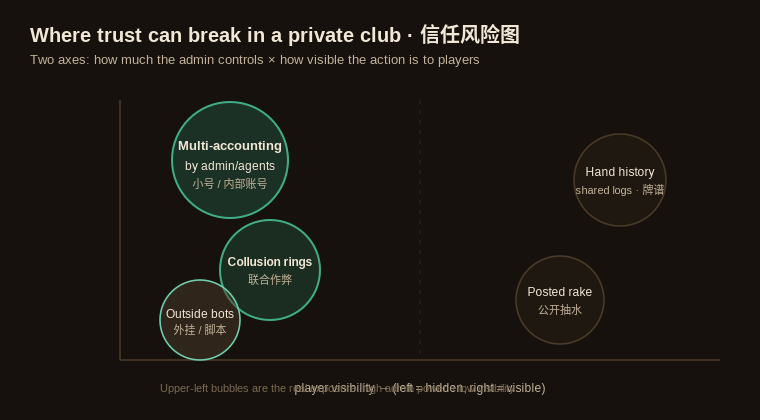
Multi-accounting (小号)
In the simplest abuse, the admin or an agent seats additional accounts they control at your table. Even played honestly, those seats gather information; played dishonestly, they coordinate. This is the single most common complaint in private clubs, and it needs no fancy software at all.
Collusion (联合作弊)
Two or more players sharing what they hold turns a fair table sharply against everyone else. In a club where the admin chooses who sits, assembling a quiet ring is far easier than on a public site with random seating and anti-collusion monitoring.
Settlement power
Even if every hand is clean, the admin owns the ledger. Slow-paying when they lose, or quietly adjusting rake-back, is a fairness failure that has nothing to do with the cards. See the club economy piece for how that chain works.
How conduct abuse is actually caught
The abuses that matter most leave traces in the data. The same detection methods work on a public site or in a well-run club. Collusion and multi-accounting produce statistical patterns, not magic. Over enough hands, they distort patterns that honest play does not.
- Pairwise behaviour. Two colluding accounts rarely stack each other and tend to avoid raising into one another; their head-to-head results skew in ways random opponents' do not. Win/loss transfer concentrated between a small set of seats is the classic fingerprint.
- Timing and presence. Accounts that almost always appear together, sit out together, and never play when the other is absent suggest one operator behind several seats, which is the multi-accounting (小号) tell.
- Action regularity. A grinding bot is often too consistent: identical timing, no tilt after a bad beat, a strategy that never drifts. Humans are noisier. Unnatural regularity over volume is what flags automation, not any single hand.
In a private club, these methods do not fail, but the person who would run them is the admin, who may be the beneficiary of the abuse. Detection is a solved-enough problem; who has both the data and the incentive to act on it is the unsolved one. The unresolved problem is governance, not technology.
Where do bots fit?
Lower on the list than the search volume suggests. A bot in a private club is most realistically a grinding tool: it plays patiently, never tilts, and harvests small edges over many hands. It beats undisciplined humans without seeing your cards. That advantage is not an exploit.
| Concern | Needs admin power? | How real |
|---|---|---|
| RNG / deal rigged | No (would need server access) | Low; usually misread variance |
| Multi-accounting (小号) | Yes | High; the most common abuse |
| Collusion ring | Helped by it | High in curated clubs |
| Grinding bot | No | Moderate; an edge, not theft |
| Unfair settlement | Yes | High; pure governance risk |
The worst risks cluster around privileged position, not around an AI in a seat. A bot can make a bad actor more efficient, but the source of unfairness is the concentration of control.
A club can be fair in the deal (clean RNG, no leaked cards) and still be unfair in conduct if the admin runs small accounts and controls who you face. A club with no bots can be trustworthy if its governance is transparent. Software alone does not determine fairness. The people and the rules they follow also matter.
Structural signals to watch
No single signal proves a club is honest or crooked. Taken together, these signals help assess how much to trust it.
- History availability. Can you export or review your own hand histories? A room that hands you the raw data is one that expects to be audited. A room that refuses is asking for blind faith.
- Seating control. Is seating random, or does the same handful of accounts repeatedly end up at your table? Curated seating is the precondition for both collusion and quiet small-account play.
- Settlement cadence. Does the admin pay out on time when they lose, with the same speed they collect when they win? Asymmetry here is a louder warning than any single suspicious hand.
- Account churn. A steady stream of brand-new accounts that win briefly and disappear is a classic seeding pattern; a stable, long-lived membership is a healthier sign.
This list does not include a "bot test." There is no reliable ten-second trick to spot automation from the felt. Reliable signals require statistical analysis and scrutiny of the club's structure.
Practical posture
If you study or play in these environments, judge a club by its governance, not its marketing: how transparent is settlement, can you see hand histories, how is seating decided, and how does the admin behave when they lose? Those answers tell you more about fairness than any anti-bot promise.